
NEWS
07-24, 2026
What Is Edge AI? An Essential Guide for Enterprise AI Adoption
How Much Energy Does AI Inference Use? Why Edge AI Infrastructure Matters
When you ask ChatGPT to write a business proposal, a complete response may appear within seconds. Behind that simple interaction, processors execute the model, memory holds model data, storage retrieves information, and networks transfer requests and results.
Every AI response uses computing resources and electricity. For enterprises moving from AI experiments to production deployment, these resource requirements can directly affect performance, operating costs, and scalability.
How Much Electricity Does One AI Query Use?
There is no fixed energy consumption for an AI query. Actual usage varies according to the model, prompt and output length, reasoning complexity, hardware efficiency, utilization, and data center environment.
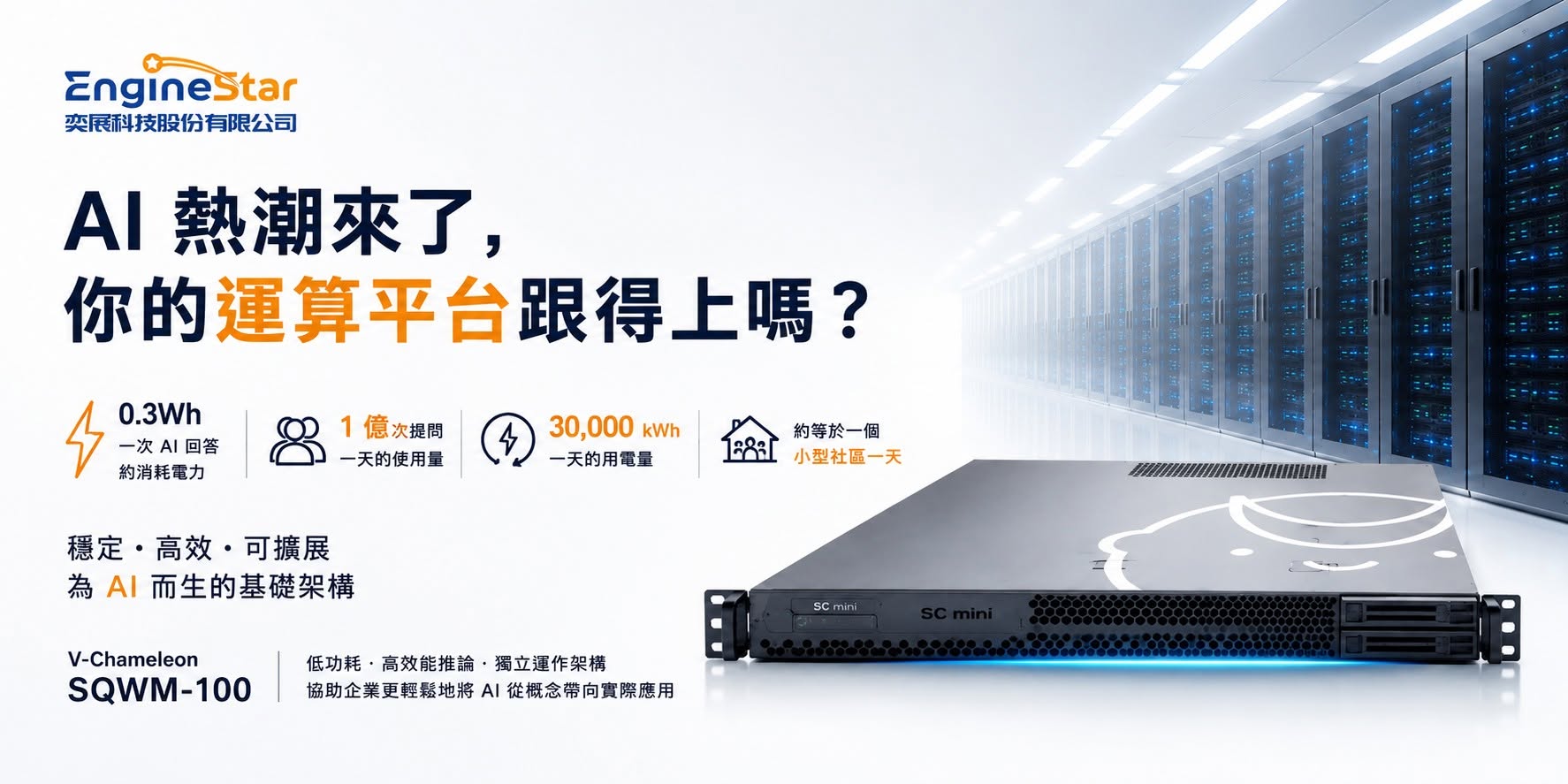
Available estimates place a typical ChatGPT query at approximately 0.3 to 0.34 Wh, but this figure should not be applied to every AI workload. Long responses, advanced reasoning, and image or video generation may require considerably more computing.
At an estimated 0.3 Wh per request:
0.3 Wh × 100 million daily queries = 30,000 kWh
The impact of one request may appear small, but electricity, cooling, and computing requirements become important infrastructure considerations when AI operates continuously and at scale.
Enterprises should therefore evaluate more than energy per prompt:
- Daily and peak request volume
- Model size and inference complexity
- Average input and output length
- Required response time
- Hardware utilization
- Power and cooling capacity
- Cost per completed task
What Infrastructure Challenges Do Enterprises Face?
Once an AI project moves into production, model selection is only one part of the decision. The underlying infrastructure must support real users, business data, and continuous operation.
Computing Performance
AI inference must deliver results within an acceptable time. Insufficient processing power, memory capacity, or data-transfer performance can increase latency or prevent a model from running properly.
Concurrent Workloads
A proof of concept may handle only a few requests. A company-wide or customer-facing service may need to support many users, devices, or data streams at the same time.
Power and Cooling
AI systems can operate under sustained workloads. Power delivery, cooling capacity, and environmental conditions directly affect stability and long-term operating costs.
Future Expansion
Models, datasets, and application requirements change over time. The infrastructure should allow for additional capacity, storage, model updates, and system integration.
These challenges are among the reasons enterprises are evaluating Edge AI.
What Is Edge AI?
Edge AI runs AI models on devices or servers located near the source of the data instead of sending every workload to a remote cloud environment.
A typical cloud AI workflow is:
Data Source → Network → Cloud AI → Result
An Edge AI workflow is:
Data Source → Local AI Inference → Result or Event
Edge AI does not have to replace the cloud. Many organizations use a hybrid architecture in which edge systems handle time-sensitive inference, while cloud or data center platforms manage model updates, centralized reporting, long-term storage, and cross-site analysis.
What Are the Benefits of Edge AI?
Lower Latency
Local inference reduces the distance data must travel before it can be analyzed. This is valuable for applications that require rapid detection or decision-making, including industrial inspection, smart surveillance, and equipment alerts.
Reduced Bandwidth Demand
Cameras, sensors, and industrial systems can generate large volumes of continuous data. Edge AI can process this data locally and transmit only relevant events, metadata, or selected records.
Greater Data Control
Processing sensitive video, documents, or operational data on-site can reduce the amount of raw data sent outside the local environment.
However, local processing alone does not guarantee security. Access control, encryption, network segmentation, software updates, and retention policies remain essential.
Improved Operational Resilience
Selected AI functions can continue operating locally when external connectivity is limited or temporarily unavailable. This is important for factories, transportation sites, remote facilities, and other environments that require continuous operation.
Which Applications Are Suitable for Edge AI?
Edge AI is worth evaluating when an application requires real-time processing, generates large volumes of data, or must limit its dependence on cloud connectivity.
Common applications include:
- Automated optical inspection
- Production-line and workplace-safety monitoring
- Object and anomaly detection
- License plate recognition
- Traffic and pedestrian analysis
- Smart retail and people counting
- Predictive equipment maintenance
- Local document processing
- AI services at remote or disconnected sites
Cloud infrastructure may remain more appropriate when workloads require rapid access to large pools of computing resources, frequent changes to large models, or centralized processing across many locations.
The correct choice may be edge, cloud, or a combination of both.
Why Is AI Infrastructure Critical to Deployment?
A model determines what an AI application can do. The infrastructure determines whether it can do it reliably, at the required speed, and within budget.
Before selecting an AI platform, enterprises should confirm:
- Whether the model and software framework are supported
- Whether sufficient memory is available
- Whether latency and throughput meet the target
- Whether the system can support expected concurrency
- Whether power, cooling, and space fit the location
- Whether the platform integrates with existing systems
- Whether monitoring, updates, and maintenance are available
- Whether capacity can expand as workloads grow
The highest specification is not always the best choice. Enterprises should benchmark their actual model and data to identify the most appropriate balance of performance, power consumption, and cost.
V-Chameleon SQM-100: Built for Edge AI Inference
The EngineStar V-Chameleon SQM-100 is a 1U AI server designed for enterprise inference and Edge AI applications.
Built on an Arm architecture and equipped with the Mobilint MLA100 NPU, it delivers up to 80 TOPS of AI inference performance for compatible deep learning workloads.
Potential applications include:
- Image recognition
- Object detection
- Automated optical inspection
- Smart surveillance
- Manufacturing analytics
- Other supported Edge AI workloads
NPU Acceleration
An NPU, or Neural Processing Unit, is a processor designed to accelerate AI operations. The SQM-100 uses NPU computing to support efficient execution of compatible inference models.
Power-Efficient Architecture
The platform is designed to reduce the power and cooling requirements associated with continuous AI inference, helping enterprises manage long-term operating costs.
Standalone Local Operation
Core inference workloads can run locally without complete dependence on remote cloud connectivity. This supports deployment in environments where latency, data control, or network availability is a concern.
Compact 1U Design
The rack-mount form factor is suitable for data rooms, factory cabinets, control centers, and distributed edge sites where installation space may be limited.
TOPS is a theoretical measure of computing capability and does not represent application performance on its own. Results depend on model architecture, numerical precision, input format, software optimization, and concurrent workload. Testing with the intended model and data is recommended before deployment.
Frequently Asked Questions
Is Edge AI always more energy-efficient than Cloud AI?
Not always. Edge AI can reduce data transmission and some cloud-computing requirements, but total energy use depends on the model, device efficiency, utilization, and number of deployed systems.
What is the difference between Edge AI and edge computing?
Edge computing processes data near its source. Edge AI is a type of edge computing that specifically runs AI models on local devices or servers.
Which enterprises should consider Edge AI?
Organizations that need real-time processing, local data control, reduced network dependence, or distributed deployment should consider Edge AI. Common sectors include manufacturing, retail, transportation, security, and smart buildings.
Can Edge AI replace the cloud?
It does not have to. Many enterprises use Edge AI for local inference and the cloud for centralized management, model updates, analytics, and long-term storage.
What should enterprises test before deploying Edge AI?
They should test model accuracy, latency, throughput, memory requirements, power consumption, compatibility, and long-term stability using representative production data.
Build AI on the Right Infrastructure
AI deployment depends on more than model capability. The computing platform must also deliver the required performance, reliability, and cost efficiency under real operating conditions.
For organizations planning computer vision, smart manufacturing, surveillance, or other local inference applications, the V-Chameleon SQM-100 provides a purpose-built platform for evaluating Edge AI deployment.
Explore the V-Chameleon SQM-100 or contact EngineStar to discuss your AI inference requirements.
[View V-Chameleon SQM-100 Product Details →]
