
NEWS
06-17, 2026
Beyond GPU Servers: A New Approach to Enterprise AI Inference with Charmeleon SQWM100
AI Inference Server vs. GPU Server: Which Is Right for Enterprise AI?
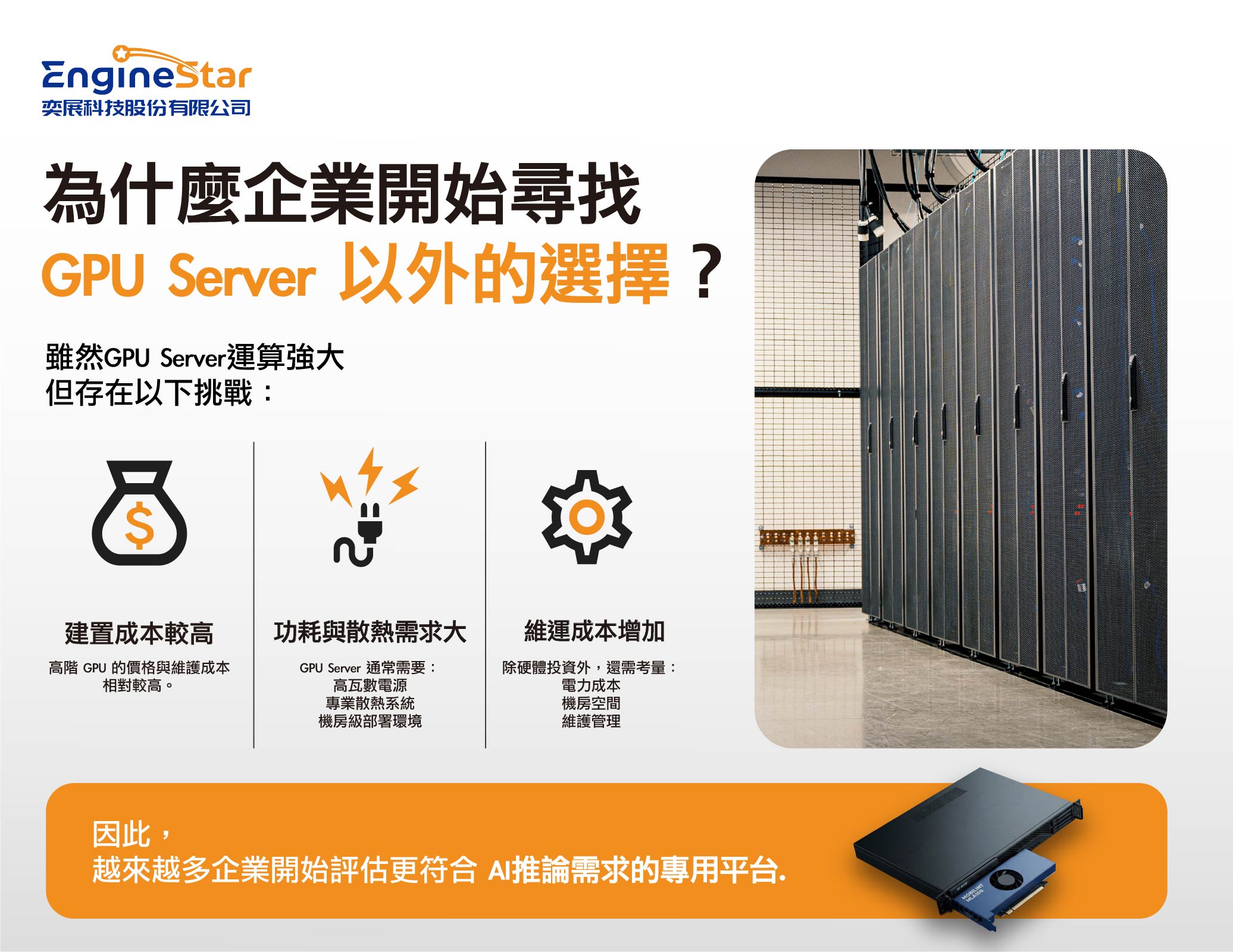
When enterprises adopt AI, GPU servers are often the first computing platform they consider. GPUs provide the parallel processing performance required for model training and many demanding inference workloads.
However, most enterprises are not training large AI models from scratch. They are deploying trained models for tasks such as visual inspection, object detection, smart surveillance, people counting, and anomaly detection.
For these applications, the better question is not “Which server is the most powerful?” but:
Which computing platform can meet the required accuracy, latency, throughput, power, and budget?
A purpose-built AI inference server may offer a more practical option when the workload is stable, clearly defined, and supported by the selected accelerator.
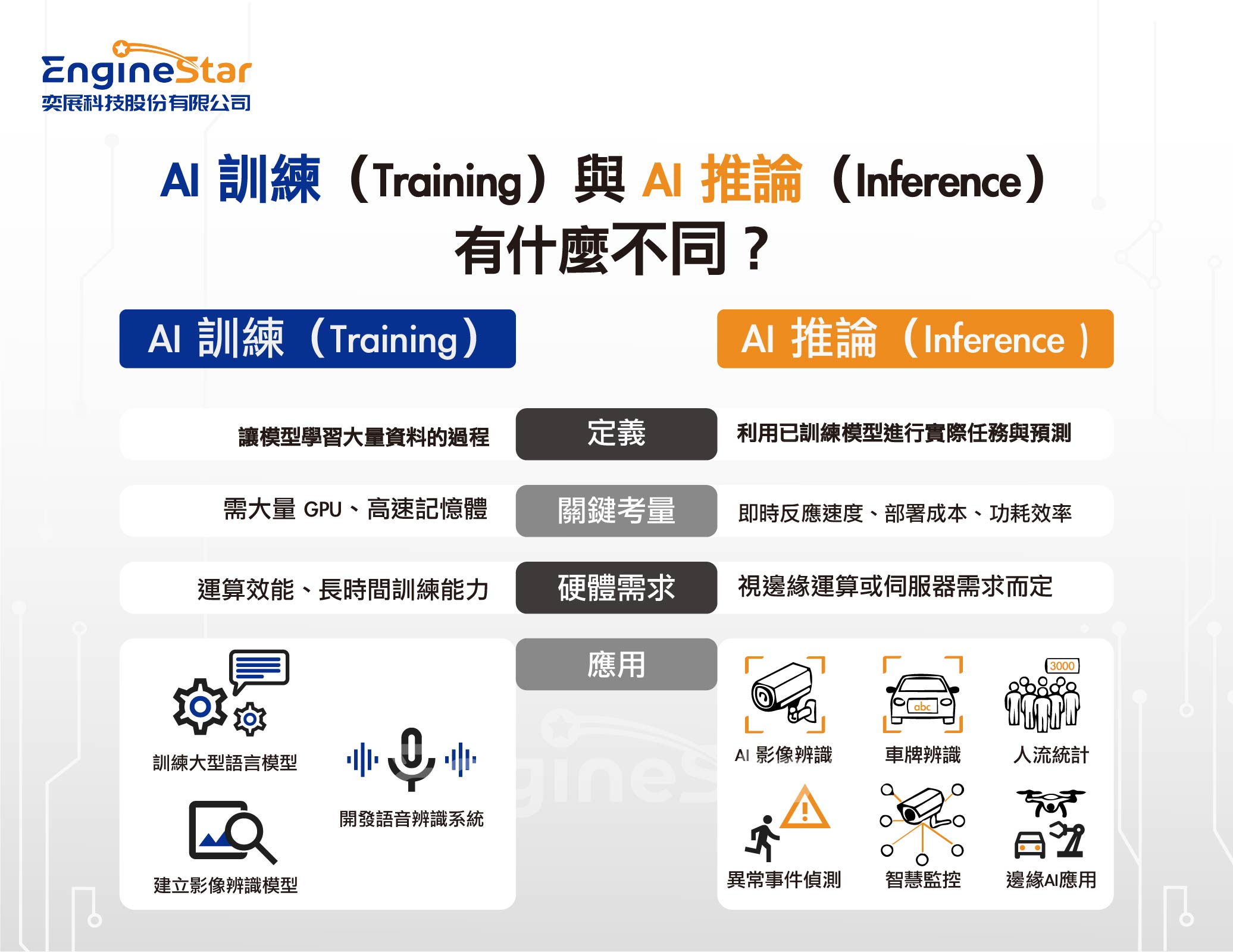
What Is the Difference Between AI Training and AI Inference?
AI training creates or updates a model from data, while AI inference uses a trained model to generate predictions or results. The two processes have different infrastructure requirements.
AI Training
AI training involves processing large datasets to teach a model how to perform a task. Examples include:
- Training a large language model
- Developing a computer vision model
- Fine-tuning a model with domain-specific data
- Building a speech recognition system
Training workloads are typically compute-intensive and throughput-oriented. Depending on the model scale, they may require multiple high-performance GPUs, large memory capacity, fast storage, and high-bandwidth networking.
AI Inference
AI inference uses a trained model to process new data and produce an output. Examples include:
- Detecting defects in production images
- Recognizing vehicles or license plates
- Counting people in a defined area
- Identifying unusual events
- Analyzing video streams in real time
Inference systems are usually evaluated by response latency, throughput, model compatibility, power consumption, reliability, and cost per task.
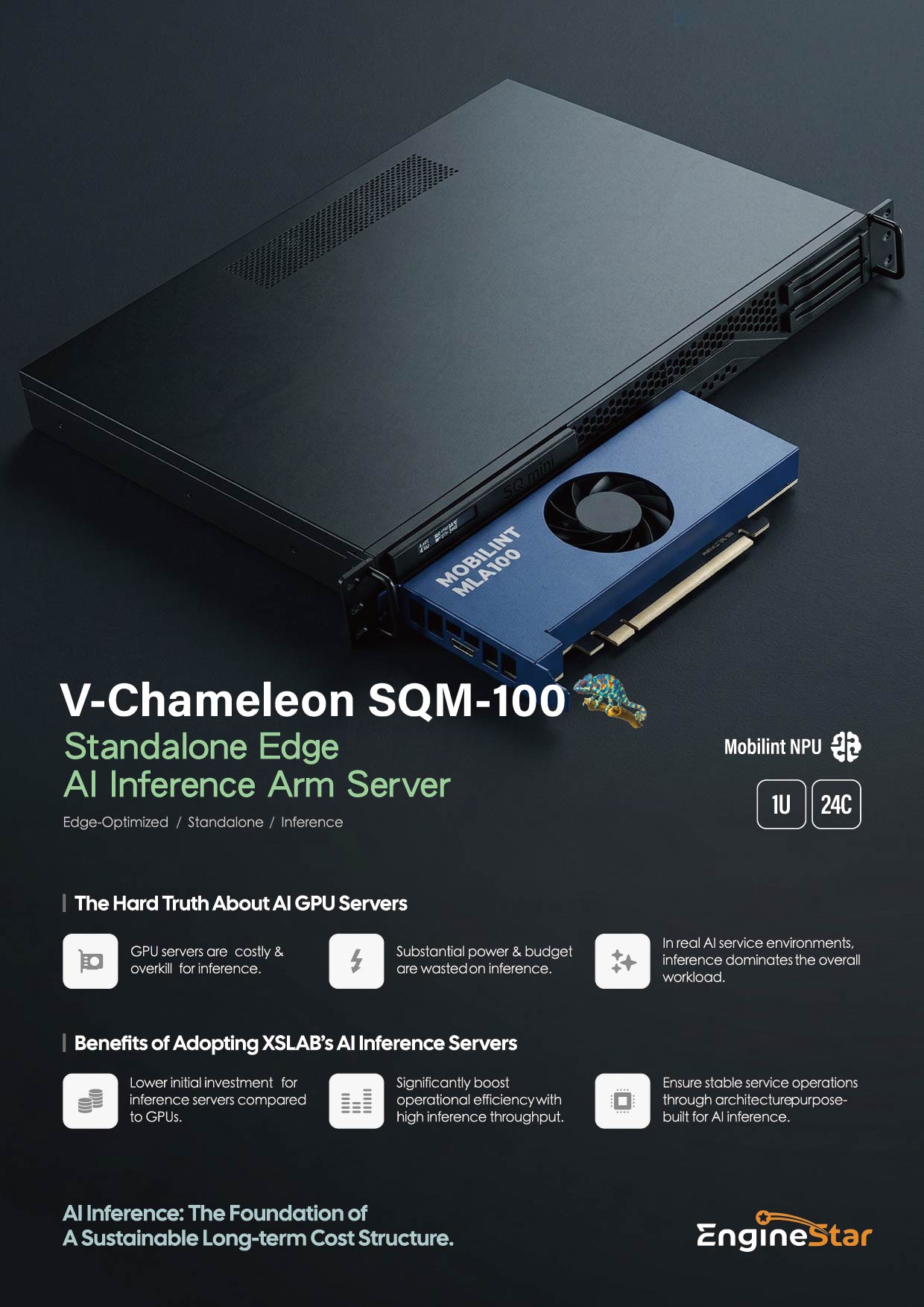
Charmeleon SQWM100: A Dedicated AI Inference Server
The Charmeleon SQWM100 is a standalone AI inference server designed for edge and enterprise inference workloads.
It combines an ARM-based platform with the Mobilint MLA100 NPU to support power-efficient AI processing in a compact 1U system. The platform is intended for organizations that need local inference without deploying a large GPU server.
Up to 80 TOPS of AI Performance
The Mobilint MLA100 integrates the ARIES NPU and provides up to 80 TOPS of AI computing performance.
Depending on model compatibility and optimization, it can support workloads such as:
- Image classification
- Object detection
- Video analytics
- Smart surveillance
- Visual inspection
TOPS is a theoretical measure of computing capability. Actual application performance also depends on the model architecture, numerical precision, input resolution, preprocessing, software stack, and number of concurrent data streams.
Standalone Edge AI Deployment
The SQWM100 can operate as a dedicated inference platform near the source of the data.
Processing data locally may help reduce network dependency and avoid sending every video stream or image to a remote cloud service. Actual data-security benefits depend on the complete application architecture and security controls.
ARM-Based Architecture
The ARM-based platform is designed to balance computing performance and energy efficiency for continuous inference workloads.
Before deployment, enterprises should confirm application compatibility, operating-system requirements, model support, development tools, and integration with existing systems.
Compact 1U Form Factor
The 1U design supports deployment in environments where rack space is limited, including:
- Factory equipment rooms
- Security control centers
- Campus server rooms
- Retail locations
- Edge computing sites
Where Can the Charmeleon SQWM100 Be Used?
The SQWM100 is suited to supported computer vision and edge AI workloads that require local, continuous inference.
Smart Surveillance
- People and vehicle counting
- Intrusion detection
- License plate recognition
- Event and anomaly detection
- Multi-camera video analytics
Smart Manufacturing
- Production-line monitoring
- Visual quality inspection
- Equipment-area monitoring
- Workplace safety detection
Smart Retail
- Foot-traffic analysis
- Queue monitoring
- Store occupancy measurement
- Customer-flow heatmaps
Smart City Applications
- Traffic-flow analysis
- Public-space monitoring
- Vehicle detection
- Real-time event analysis
Each deployment should be validated with the actual model, camera streams, image resolution, accuracy target, and operating conditions.
How Should Enterprises Choose an AI Inference Server?
The right inference server is the platform that meets the target model accuracy, latency, throughput, compatibility, and total cost within the intended environment.
Before selecting a system, evaluate:
-
Model compatibility
Confirm that the accelerator and software stack support the required model architecture, operators, framework, and numerical precision. -
Real-world performance
Test the model with representative images, videos, prompts, or sensor data. Do not rely on TOPS alone. -
Latency and throughput
Define the required response time, frames per second, number of video streams, and concurrent requests. -
Accuracy after optimization
Quantization or model conversion may affect output quality. Compare results against the original model. -
Power and cooling
Verify that the deployment location can support the server’s electrical and thermal requirements. -
System integration
Review camera interfaces, networking, storage, APIs, application software, and monitoring requirements. -
Scalability and maintenance
Consider how the system will handle additional workloads, model updates, software upgrades, and hardware replacement. -
Total cost of ownership
Include hardware, electricity, cooling, rack space, software integration, and ongoing maintenance.
GPU Server or NPU Inference Server?
| Evaluation Area | GPU Server | NPU Inference Server |
|---|---|---|
| Primary strength | Flexible accelerated computing | Purpose-built AI inference |
| Model training | Strong choice | Usually limited or unsupported |
| AI inference | Strong choice | Core workload |
| Model flexibility | Generally broad | Depends on supported models and operators |
| Power requirements | Often higher | Designed for power-efficient inference |
| Deployment environment | Data center, cloud, edge | Edge and dedicated inference environments |
| Best suited for | Large, complex, or changing workloads | Stable, supported production workloads |
A GPU server remains appropriate when flexibility, model size, training capability, or broad software compatibility is the priority.
An NPU inference server becomes attractive when the workload is supported, production requirements are predictable, and power-efficient local processing is important.
Choose AI Infrastructure Based on the Workload
Not every AI application requires the largest available GPU server.
For model training, large generative models, and workloads that require broad framework flexibility, GPU servers remain a strong choice. For supported computer vision, smart surveillance, manufacturing inspection, and edge AI inference, a dedicated NPU server may provide a more focused deployment path.
The best approach is to test the actual model and data before making an infrastructure decision.
Evaluate the Charmeleon SQWM100 for your AI inference workload.
[Contact EngineStar to Discuss Your AI Inference Requirements →]
