
NEWS
06-17, 2026
Edge AI Server: A Smarter Approach to Enterprise Visual Analytics
Edge AI Server for Enterprise Video Analytics
AI-powered video analytics is increasingly used in smart manufacturing, smart cities, retail, campuses, and security operations. However, sending every camera stream to the cloud or a central data center can increase latency, bandwidth usage, storage demand, and infrastructure costs.
An Edge AI server processes video and runs AI inference closer to where the data is generated. This gives enterprises a practical way to build responsive visual analytics systems while reducing dependence on centralized computing resources.
What Is an Edge AI Server?
An Edge AI server is a computing system deployed near cameras, sensors, or other data sources to process information locally.
Traditional cloud architecture:
Camera → Network → Cloud or Data Center → AI Analysis → Result
Edge AI architecture:
Camera → Edge AI Server → Local AI Analysis → Result
Instead of continuously transmitting all raw video to a remote location, the system can analyze footage locally and send selected events, metadata, alerts, or recordings to the central platform.
Why Use Edge AI for Video Analytics?
Faster Response for Real-Time Events
Local inference reduces the network distance between data capture and AI analysis. This is especially useful for applications that require rapid detection and response, including:
- Intrusion detection
- Safety alerts
- License plate recognition
- People and vehicle counting
- Traffic-event detection
- Production-line monitoring
Actual response time depends on the AI model, number of video streams, image resolution, hardware configuration, and system integration.
Lower Bandwidth Requirements
High-resolution cameras generate continuous video streams. Transmitting every stream to a central data center or cloud platform can place considerable demand on network infrastructure.
An Edge AI server can process video locally and transmit only the required results. This may reduce bandwidth usage and help enterprises make better use of existing network capacity.
More Control Over Video Data
Local processing can reduce the amount of sensitive video that must leave the deployment site. This may support data-governance and privacy requirements in factories, campuses, government facilities, and other controlled environments.
Security still depends on the complete system design, including access control, encryption, network segmentation, data retention, and software maintenance.
Greater Operational Resilience
Edge processing allows selected AI functions to continue locally when cloud connectivity is limited or unstable. This can be important in factories, remote facilities, and distributed surveillance environments.
Where Can Edge AI Servers Be Used?
Smart Manufacturing
Edge AI can support production and workplace monitoring close to the factory floor.
Common applications include:
- Visual quality inspection
- Production-line monitoring
- Equipment-area surveillance
- Personal protective equipment detection
- Restricted-area alerts
- Workplace safety monitoring
Smart Surveillance
AI inference can turn conventional video feeds into actionable events rather than relying only on manual review.
Possible applications include:
- People and vehicle detection
- Intrusion alerts
- License plate recognition
- Crowd monitoring
- Anomaly detection
- Event-based recording
Smart Cities and Transportation
Local video analytics can help process traffic and public-space data near the point of capture.
Applications may include:
- Traffic-flow monitoring
- Vehicle classification
- Intersection analysis
- Parking management
- Pedestrian counting
- Public-safety alerts
Retail and Commercial Spaces
Retailers and property operators can use visual data to understand traffic patterns and improve site management.
Applications include:
- Foot-traffic counting
- Queue monitoring
- Occupancy analysis
- Customer-flow heatmaps
- Entrance and exit monitoring
- Security-event detection
Campuses and Business Parks
Edge AI servers can support distributed camera environments across schools, offices, industrial parks, and public facilities.
Typical uses include:
- Access-area monitoring
- Perimeter security
- Incident alerts
- Vehicle management
- Centralized video management
V-SQ mini Chameleon: Edge Processing for Smart Surveillance
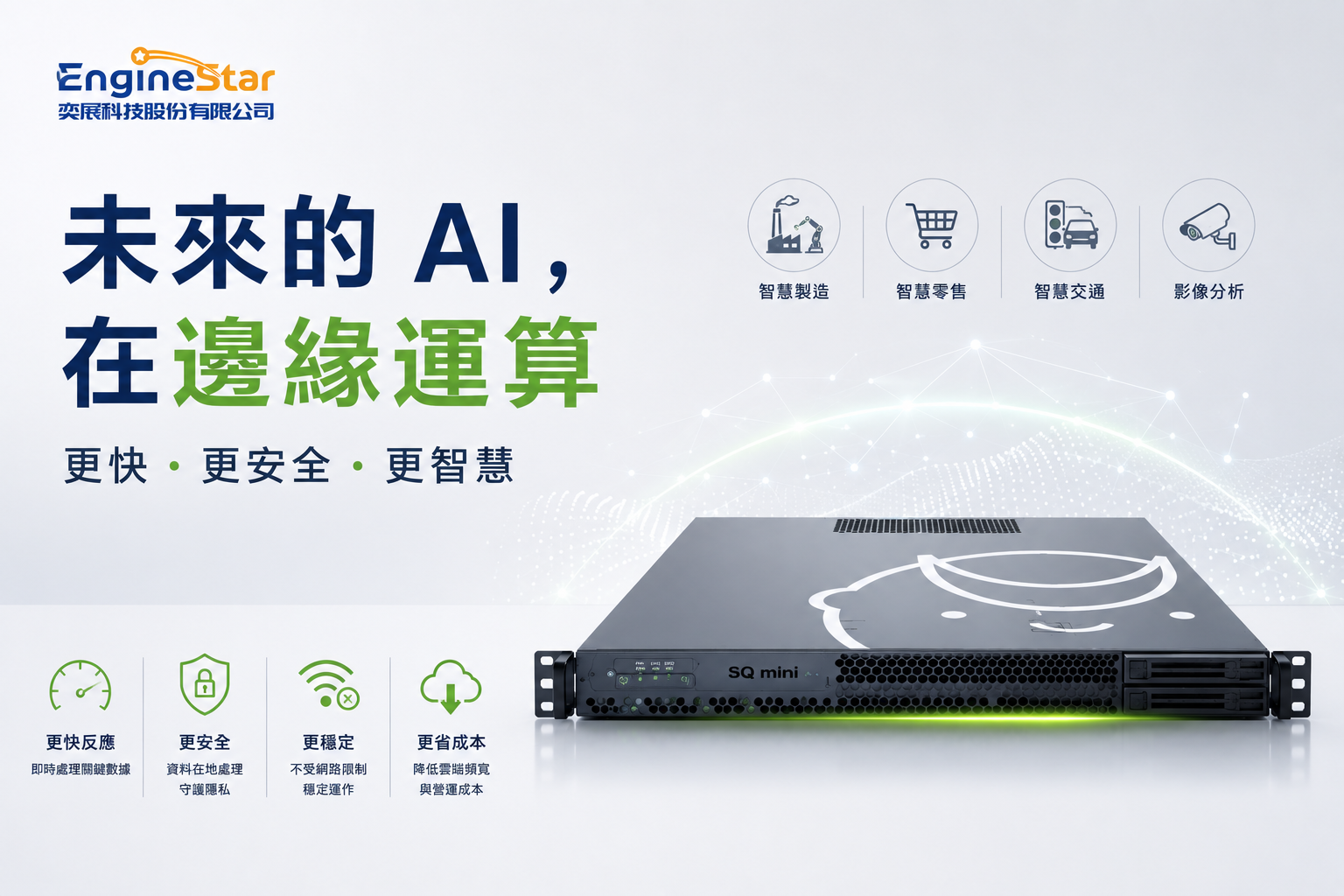
The EngineStar V-SQ mini Chameleon is a compact Edge AI server designed for video management, intelligent analysis, and smart surveillance applications.
It combines an efficient Arm-based computing platform with local AI processing capabilities, helping enterprises deploy visual analytics closer to cameras and operational sites.
Efficient 24-Core Arm Architecture
The V-SQ mini Chameleon uses a 24-core Arm v8-based processor designed to balance performance and power efficiency for continuous edge workloads.
This architecture is suitable for environments where power consumption, cooling capacity, system size, and operational stability must all be considered.
Integrated Video Management
With integrated NX Witness VMS, the platform supports centralized management of up to 100 CCTV cameras.
Camera-management capacity and simultaneous AI analytics performance are different considerations. The number of streams that can be analyzed in real time depends on factors such as:
- Video resolution and frame rate
- Video codec
- AI model complexity
- Number of analytics functions
- Required detection accuracy
- Overall system configuration
A proof of concept using actual camera streams is recommended before full deployment.
Local AI Video Analytics
The V-SQ mini Chameleon can support compatible AI models and applications for use cases such as:
- People counting
- License plate recognition
- Facial recognition
- Object detection
- Event and anomaly detection
- AI-assisted security monitoring
Model compatibility and performance should be confirmed according to the selected software, model, and deployment requirements.
Compact 1U Design
The compact 1U form factor allows the system to be installed in space-constrained environments, including:
- Factory server cabinets
- Security control rooms
- Campus equipment rooms
- Retail locations
- Traffic-control sites
- Distributed edge nodes
Edge AI Server vs. Centralized AI Server
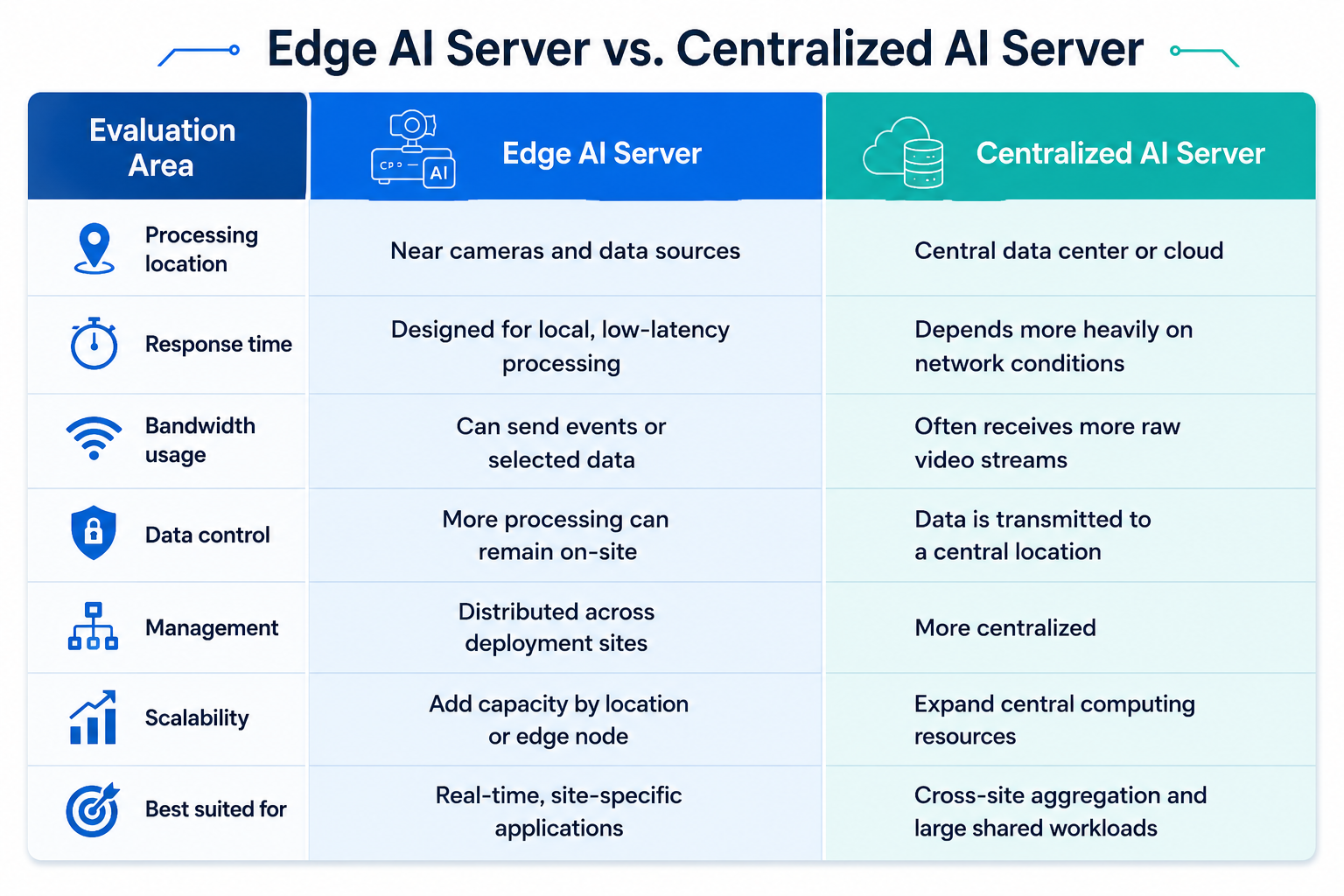
Edge and centralized architectures are not mutually exclusive. Many enterprises use a hybrid design: local servers handle time-sensitive inference, while central systems manage reporting, model updates, long-term storage, and analysis across multiple sites.
How to Choose an Edge AI Server
The best Edge AI server is the platform that meets the application’s performance, compatibility, and operating requirements—not simply the system with the highest specifications.
Before deployment, evaluate:
-
Camera environment
Confirm the number of cameras, resolutions, codecs, frame rates, and existing VMS. -
AI workload
Define what the system must detect, classify, count, or recognize. -
Performance target
Determine acceptable latency, throughput, accuracy, and concurrent stream capacity. -
Model compatibility
Verify that the selected AI models, frameworks, and operators are supported. -
System integration
Review APIs, event notifications, storage, networking, dashboards, and third-party software. -
Deployment environment
Check rack space, power, cooling, temperature, connectivity, and physical security. -
Data governance
Define how video, metadata, alerts, and logs will be stored and protected. -
Expansion requirements
Consider future cameras, additional AI functions, software updates, and multi-site management.
Bring Real-Time Intelligence Closer to the Data
An Edge AI server enables enterprises to process video closer to cameras, respond to events more quickly, and reduce the need to transmit every stream to centralized infrastructure.
For smart surveillance, manufacturing, transportation, retail, and campus applications, the V-SQ mini Chameleon provides a compact platform that combines video management and Edge AI processing in a single system.
Evaluate the V-SQ mini Chameleon with your actual cameras, AI models, and performance requirements.
[Contact EngineStar to Discuss Your Edge AI Project →]
